This Excel workbook is a lawn care working capital forecast for estimating the short-term cash needed to support seasonal operations. It organizes expected customer receipts and operating payments into a weekly working capital view based on their dates, amounts, and confidence percentages.
Operators can use the XLSX to monitor projected ending cash, compare it with a chosen minimum reserve, identify reserve gaps, and decide whether to adjust spending, collection timing, or financing plans. The included transactions and Spruce Kite Lawn Studio business name are fictional examples.
How this workbook can help
- See how seasonal receipts and payments may affect cash week by week.
- Estimate additional cash needed to maintain an editable minimum operating reserve.
- Account for uncertainty by applying confidence percentages to planned cash items.
- Identify incomplete transaction entries before relying on the forecast results.
What is in the file
How to get started
1. Set the forecast assumptions
Open the Assumptions sheet and update the forecast start date, opening cash balance, minimum cash reserve, and forecast duration. The workbook supports a forecast period of 1 through 26 weeks.
2. Enter expected cash activity
Use the yellow input cells on the Cash Plan sheet to record each expected receipt or payment. Enter the cash date, flow, category, customer or vendor, property or purpose, status, gross amount, confidence percentage, and any useful notes.
3. Resolve transaction alerts
Check the Review Alert column for missing or invalid information. Correct flagged dates, flow types, categories, counterparties, purposes, statuses, amounts, or confidence values before interpreting the totals.
4. Review the weekly forecast
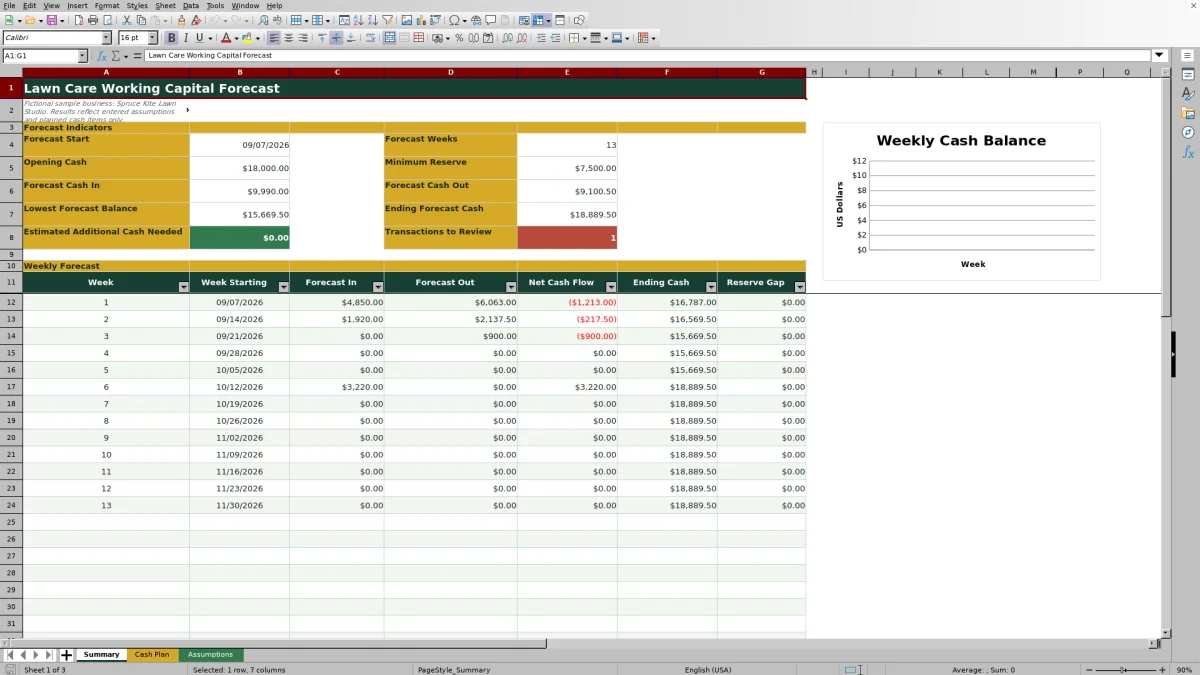
Use the Summary sheet to examine forecast cash in, forecast cash out, net cash flow, ending cash, reserve gaps, the lowest projected balance, estimated additional cash needed, and the ending-cash chart. Update the plan as customer payment dates or operating costs change.
The Seasonal Cash Situation
Lawn care companies may pay crews, fuel trucks, maintain equipment, and purchase materials before customer payments arrive. Revenue can also shift with weather, contract schedules, fall cleanups, or delayed collections. This workbook frames that timing problem as a weekly cash forecast rather than treating seasonal profitability and immediate liquidity as the same issue.
Action: Build the Cash Plan
Start with the Assumptions sheet, where the forecast date, opening cash, reserve target, and number of weeks control the planning horizon. Then record expected receipts and payments on the Cash Plan sheet. Each gross amount is multiplied by its confidence percentage, so a $1,000 item at 80% confidence contributes $800 to the forecast. Cash Out items are carried into the weekly summary as outflows, while Cash In items are carried in as receipts.
Result: Interpreted Practical Example
Situation: The fictional sample starts September 7, 2026, with $18,000 in cash and a $7,500 minimum reserve. Action: Consider the three visible opening-week items: a $1,850 receipt at 100% confidence, $5,400 of payroll at 100%, and $780 of fuel at 85%. Result: The weighted fuel payment is $663, producing a projected balance of $13,787 after those three items: $18,000 + $1,850 − $5,400 − $663. Interpretation: That partial calculation remains $6,287 above the reserve, but it does not include any other transactions entered for the week or later weeks. Next decision: Review the complete Summary before deciding whether to delay a purchase, accelerate collections, or arrange short-term funding.
Interpret the Reserve Gap and Funding Estimate
The Summary compares projected ending cash with the minimum reserve entered on the Assumptions sheet. A weekly reserve gap indicates how far the projected balance falls below that operating cushion. The estimated additional cash needed is based on the lowest forecast balance relative to the reserve, so it is a planning estimate driven by entered transactions and confidence assumptions rather than a lending recommendation.
Common Errors and Solutions
If a transaction is excluded or appears incorrect, first inspect its Review Alert. Enter all required fields, use a valid cash date, select Cash In or Cash Out, provide a numeric gross amount, and keep confidence between the configured minimum and maximum. If weekly totals look too high or low, check whether the transaction date falls inside the forecast horizon and whether confidence accurately reflects collection or payment uncertainty. If the reserve gap seems unrealistic, verify opening cash and the minimum reserve on the Assumptions sheet.
Comparison With Manual and Software Alternatives
The workbook is one complete operational method: assumptions establish the horizon, the Cash Plan records and weights transactions, and the Summary converts them into weekly liquidity indicators. The comparison below shows when that method or an external alternative may be more suitable.
| Method | How it handles the forecast | More suitable when |
|---|---|---|
| This Excel workbook | Combines structured cash entries, confidence weighting, weekly totals, reserve gaps, review alerts, and a summary chart. | A lawn care operator wants a reusable short-term cash plan without implementing a separate operating system. |
| Paper form or whiteboard | Records expected receipts and payments manually, with totals and changes recalculated by hand. | The operation has very few transactions and the main need is a quick team discussion rather than a maintained numerical forecast. |
| Blank spreadsheet | Allows custom calculations but requires the user to design formulas, checks, categories, and reporting. | The business has specialized forecasting rules and someone can build and maintain the spreadsheet controls. |
| Dedicated field-service software | May connect scheduling, invoicing, customer records, payments, and operational reporting within a broader platform. | The company needs integrated dispatch, job management, billing, and customer workflows in addition to cash forecasting. |
The workbook does not replace bank reconciliation, accounting records, or field-service scheduling. Its role is to turn entered cash expectations into a focused weekly working capital view.
Next Decisions for Lawn Care Operators
Review the lowest forecast balance, ending cash, reserve gaps, and transactions marked for review. If a shortage appears, test practical changes such as following up on receivables, requesting an appropriate customer deposit, changing the timing of a discretionary equipment purchase, or discussing a financing option with a qualified adviser. Update dates, amounts, and confidence percentages as conditions change so the next decision reflects current operating expectations.
Frequently asked questions
What does the lawn care working capital forecast calculate?
It calculates weekly forecast cash in, forecast cash out, net cash flow, ending cash, and reserve gaps. The Summary also reports the lowest forecast balance, ending forecast cash, and estimated additional cash needed relative to the minimum reserve.
How many weeks can the Excel forecast cover?
The Forecast Weeks assumption accepts a whole number from 1 through 26. The fictional sample is configured for 13 weeks.
How does the confidence percentage affect a cash item?
The workbook multiplies gross amount by confidence to produce the forecast amount. For example, a planned $2,000 receipt at 75% confidence contributes $1,500 to forecast cash in.
What should I do when a transaction has a review alert?
Check the row for a missing date, flow, category, customer or vendor, property or purpose, status, amount, or confidence value. Also confirm that numeric entries fall within the limits configured on the Assumptions sheet.
Does the estimated additional cash needed represent an approved loan amount?
No. It is a planning calculation based on opening cash, entered transactions, confidence percentages, the forecast horizon, and the selected minimum reserve. Actual financing needs should be evaluated with current records and appropriate financial advisers or lenders.
Editorial responsibility

Nadia KesslerEstimates, customers and job workflows

Ethan ReedWorkbook QA, crews and business controls